
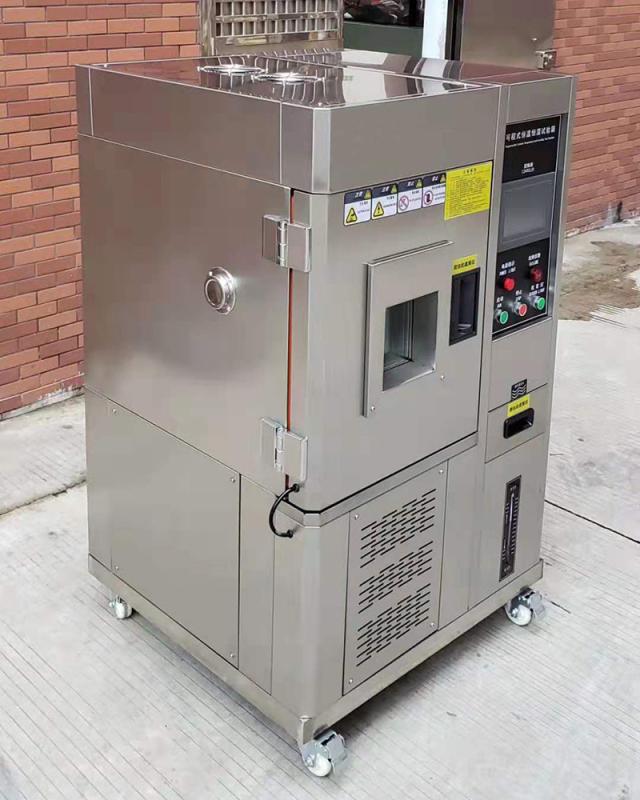
During the operation of the constant temperature and humidity test chamber, the accuracy of humidity control directly affects the reliability of the test results. At present, the two most commonly used humidity measurement methods in the industry are the wet and dry bulb method and the electronic sensor method. This article will explain the principles, advantages and disadvantages of these two methods to help you make a more appropriate judgment when choosing a device.

What is the wet and dry ball method?
The wet and dry bulb method is a traditional method of measuring humidity. It uses two temperature sensors:
Dry Ball Sensor:Directly measure the air temperature inside the test chamber.
Wet bulb sensor:Its sensing part is wrapped in special gauze, and one end of the gauze is immersed in water.
When the test chamber is running, air continues to flow through the surface of the wet bulb, and the evaporation of moisture on the gauze will take away the heat, resulting in a lower wet bulb temperature than the dry bulb temperature. The drier the air, the faster the moisture evaporates and the greater the temperature difference. The controller calculates the current relative humidity based on the difference between dry bulb temperature and wet bulb temperature through built-in formulas.
1) Advantages of wet and dry ball method:
Good stability: The core component is the temperature sensor, which is mature and not prone to data drift after long-term use.
Lower cost: Compared with high-precision electronic sensors, their manufacturing costs and maintenance costs are more advantageous.
Easy to calibrate: Since the essence is to measure temperature, just calibrate the temperature sensor and the process is simple.
2) Disadvantages of wet and dry ball method:
High maintenance requirements: Wet bulb gauze requires regular inspection and replacement. If the gauze becomes dirty, hard, or scaled, it can cause inaccurate humidity readings.
There are requirements for water quality: purified water or distilled water must be used, and minerals in ordinary tap water will clog the gauze fibers and affect the water absorption effect.
There are restrictions on use: in low temperature environments (near freezing point), gauze may freeze and not work; In very low humidity environments, the measurement accuracy also decreases.
What is the Electronic Sensor Act?
The electronic sensor method uses polymer moisture-sensitive elements, usually capacitive or resistive, to directly measure the amount of water vapor in the air. When sensitive components absorb moisture, they change their electrical properties (such as capacitance or resistance), and when the control circuit detects this change, it directly converts it into a humidity reading.
1) Advantages of electronic sensor method:
Low maintenance: no gauze and water system so there is no need to change consumables regularly or refill frequently.
Fast response speed: The electronic components are sensitive to changes in humidity and can quickly respond to humidity fluctuations in the test chamber.
Wide range of application: Under low temperature, low humidity or special working conditions, it usually performs better than the dry and wet ball method.
Easy data integration: The output signal is an electrical signal, which is convenient for connecting to a recorder or computer system for data collection.
2) Disadvantages of the electronic sensor method:
Long-term drift issues: Prolonged exposure to high temperatures, humidity, or corrosive gases can cause aging of moisture-sensitive components, leading to gradual deviations from true values.
Regular Calibration Required: To ensure accuracy, sensors often need to be sent back to the manufacturer or professional facility for calibration or replacement every year, which may involve higher maintenance expenses.
Weather Resistance Limitations: Extreme high temperature and humidity environments can accelerate the aging of sensors, affecting their service life.
How to choose?
Both methods have their own emphasis and are suitable for different usage scenarios.
If your test conditions are mainly in the conventional temperature and humidity range, and you want to have low equipment purchase costs, and are willing to arrange for simple routine maintenance (such as monthly gauze inspection), the wet and dry bulbing method is a proven and reliable option.
If your laboratory needs to operate unattended for long periods of time, or often conducts complex testing under low temperature and humidity conditions, and wants to reduce daily maintenance workload, the electronic sensor method may be a better option. It is important to note that its annual calibration fee needs to be included in the long-term cost of use.
Summary
The dry and wet bulb method and the electronic sensor method are the two mainstream humidity control methods in the constant temperature and humidity test chamber. The wet and dry ball method is stable and economical, but it has requirements for daily maintenance; Electronic sensors are convenient and sensitive, but long-term drift and calibration issues need to be addressed.
Understanding the differences between these two methods can help you choose the appropriate humidity control configuration based on actual testing needs and maintenance capabilities, ensuring accurate and reliable test data.


