
In the quality control and construction applications of coatings, inks and related liquid materials, viscosity is one of the core physical parameters. Viscosity cups are a simple and fast field and laboratory measurement tool for evaluating the kinematic viscosity of liquids by measuring the time it takes for a quantitative specimen to flow out of a standard pore size at a specified temperature. Faced with different standards and specifications of viscosity cups, a correct understanding of their classification, principles and selection principles is the basis for obtaining reliable data.
1. The working principle of viscosity cups
The essence measured by a viscosity cup is kinematic viscosity, which is usually expressed in terms of the time it takes for a certain volume of specimen to completely flow out under gravity (seconds, s). The measurement results are affected by factors such as fluid properties (Newtonian or non-Newtonian), ambient temperature, viscosity cup geometry and pore size. For Newtonian fluids, there is a definite conversion relationship between outflow time and kinematic viscosity, which can be calculated by empirical formulas. For non-Newtonian fluids, measurements are often used for production process control as conditional viscosity.
The basic conversion general expression can be expressed as:
v = K(t - c)
Among them,v is the kinematic viscosity (mm²/s or cSt),t is the outflow time (s),K With c is a constant related to the viscosity cup geometry. Different standard viscosity cups, the K With c The value is different.
2. Types of main viscosity cups
According to the common standards at home and abroad, the viscosity cups commonly used in the coating industry are mainly divided into the following categories, which have their own emphasis on design standards, structural dimensions and application scenarios.
| Type (standard) | Core features and applicable scenarios |
|---|---|
| Smear - 4 cups (GB/T 1723) | An entry-level tool with a wide range of domestic applications. Capacity 100ml, pore diameter 4mm. The optimal measured outflow time is 20 seconds to 100 seconds and is suitable for Newtonian or near-Newtonian liquids such as varnishes and colored paints. If the outflow time exceeds 150 seconds, the measurement accuracy decreases. |
| ISO flow cup (ISO 2431 / GB/T 6753.4) | International common standards, emphasizing the standardization and comparability of measurement. There are various aperture sizes such as 3, 4, 5, 6, and 8mm. The outflow time should be controlled between 30 seconds and 100 seconds to obtain stable data. It is suitable for the viscosity determination of colored paints and varnishes. |
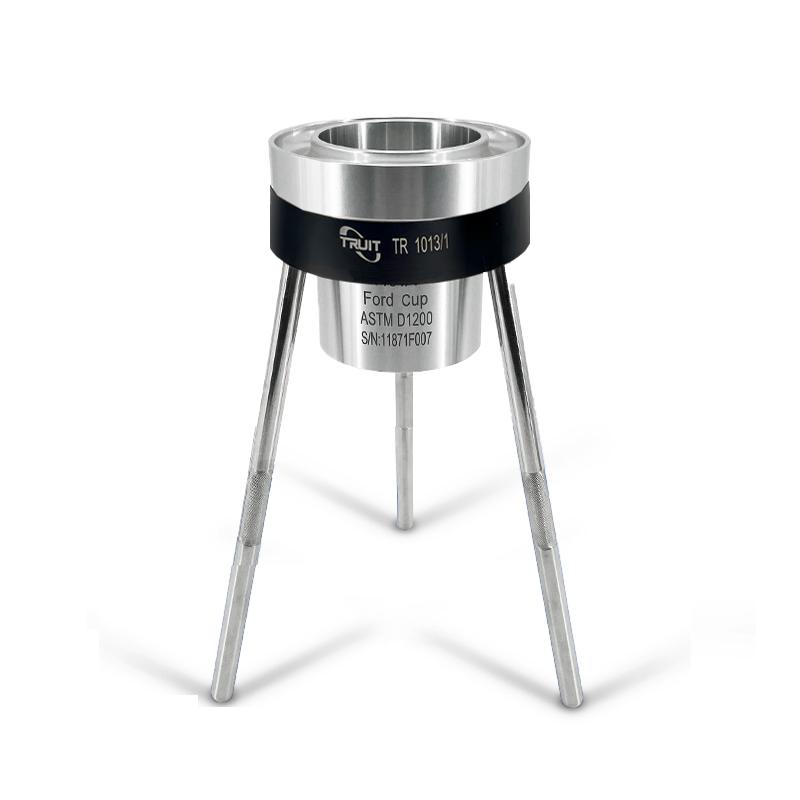
| Ford Cup (ASTM D1200) | A standard commonly adopted in North America. Common models are No. 2 to No. 5, with pore sizes ranging from 2.53mm to 5.20mm and a capacity of 100ml. It is designed for use with Newtonian or near-Newtonian fluids. |
| Cai En Cup (ASTM D4212) | Immersion design, strong portability, suitable for rapid inspection on the construction site. The cup has a capacity of 44ml and is available in five apertures from No. 1 to No. 5. When measuring, dip a clean and dry viscosity cup into the liquid and lift it quickly, recording the interruption time of the flow. |
| DIN cup (DIN 53211) | German standard design, which is widely used in Europe and ink industry. Usually 100ml volume, based on 4mm pore size (No. 4 cup), other pore sizes are also available. Structurally, it is close to Tu-4 cup, but there are differences in parameters such as taper. |
| Iwata Cup (NK-2) | Japanese standard, mainly used for on-site rapid inspection of automobiles and industrial coatings. Its pore size is fixed at 3.81mm and it is designed for fast measurements in the medium viscosity range. |
3. How to choose a viscosity cup correctly
Choosing the right viscosity cup is a prerequisite for ensuring the validity of the measurement. Improper selection can lead to too short or too long outflow times, introducing large measurement errors. It is mainly considered based on the following three dimensions:
1. Estimated viscosity range based on the sample to be tested
Each model of viscosity cup has its own optimal measurement interval. If the outflow time is too short (e.g., < 20 seconds), the flow is too fast, and the proportion of human timing error increases. If the outflow time is too long (e.g., > 100 seconds), the measurement distortion may be caused by solvent volatilization or fluid thixotropy. The estimated outflow time should fall within the recommended range for the cup number.
2. By fluid type
Most viscosity cups are designed for use with Newtonian fluids. For non-Newtonian fluids (such as some water-based coatings, high shear thinning materials), different "conditional viscosity" values will be measured for cups with different pore sizes, and the same type of cup should be used for batch-to-batch comparison to ensure the relative significance of the data.
3. According to the test standards followed
In product technical specifications or trade dealings, the test standards to be followed (such as GB/T 1723, ISO 2431 or ASTM D1200) should be clearly agreed upon. Even if the pore size of different standards is similar, the outflow time for the same fluid may be different due to structural differences such as internal taper and cup length, so they cannot be used directly interchangeably.
Fourth, key operational points
In order to ensure the repeatability and reproducibility of the measurement results, the following links should be paid attention to during operation:
Temperature control:Temperature is the main factor affecting viscosity. Before measurement, the specimen and viscosity cup should be placed in a constant temperature environment (usually 23±0.5°C or 25±1°C) and tested after the temperature is balanced.
Cleaning and Maintenance:The cup body must be thoroughly cleaned with a matching solvent before and after measurement, especially the outflow hole. Any remaining dry patent leather will change the pore size, directly affecting the measurement accuracy. Use a soft brush when washing to avoid scratching with metal tools.
Horizontal vs. Vertical:Ensure that the upper edge of the viscosity cup is horizontal (this can be achieved with a leveling screw and bubble level) when measuring, and keep the cup vertical when lifting or placing to ensure that the liquid level flows out vertically.
Readings and judgments:The stopwatch should start the moment the finger is released or the liquid level leaves the liquid level, stopping at the first interruption of the liquid flow. Three parallel measurements are usually performed, taking the arithmetic mean.
5. Summary
As a classic flow cup viscometer, viscosity cups play an important role in quality control in coatings and related industries with their simple structure, convenient operation, and moderate cost. Whether it is the domestic Tu-4 cup, or the international ISO cup and Ford cup, its core is to obtain comparable outflow time through standardized geometric size. In actual work, technicians need to carefully select the appropriate viscosity cup model based on sample characteristics, expected viscosity and implementation standards, and strictly follow the standardized operation process, so as to provide accurate and reliable viscosity data support for product development and production.