
In surface quality inspection, gloss is a very intuitive indicator. Whether the car's paint is bright enough, whether the furniture coating feels textured, and whether the plastic casing is matte or high-gloss all depend on gloss to quantitatively judge. To accurately measure glossiness, the first step is to choose the right measurement angle.
Common gloss meters on the market generally offer three standard angles: 20°, 60°, and 85°. Each of these three angles has its own use, corresponding to three types of material surfaces: high-gloss, medium-gloss, and low-gloss.
Let's start with the 60° angle. This is the most basic and universal angle, somewhat like a pan-of-all in gloss measurement. If you get a piece of material and are completely unsure about the angle to use, try it at a 60° angle first, which usually won't go wrong. A 60° angle is suitable for medium-gloss materials, roughly corresponding to surfaces with a gloss value between 10 and 70 GU. Most semi-gloss or mercerized coatings we see in daily life can basically be measured at a 60° angle. For example, ordinary coatings, furniture paints, plastic parts, wood surfaces, ceramics, and decorative paper are all typical application scenarios for 60° angles. Many international standards also list 60° as the preferred angle, and this is why.
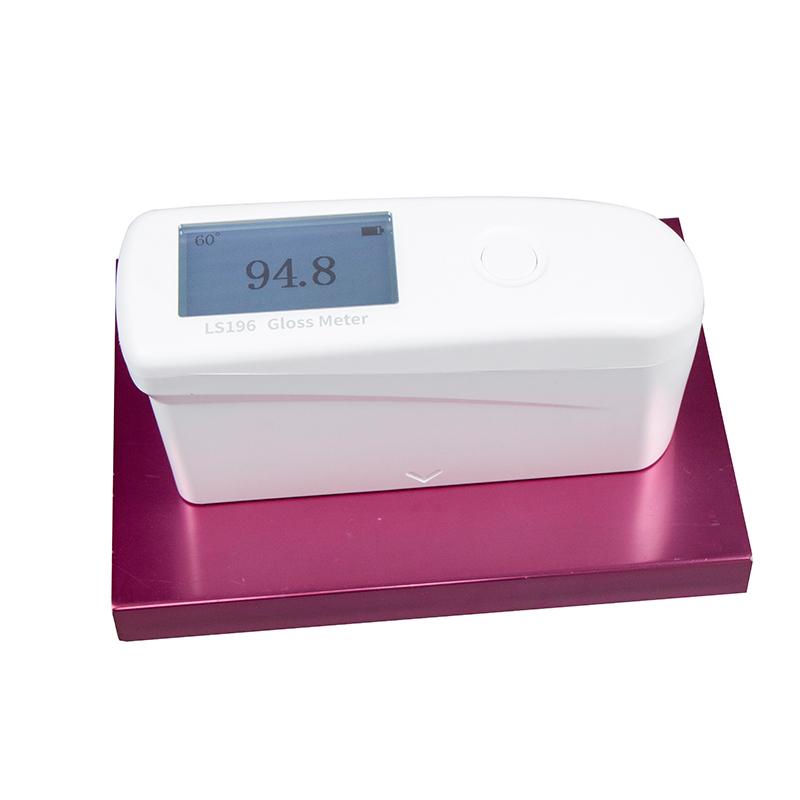
Next, let's talk about the 20° angle. When the material surface is very bright, the 60° angle is insufficient, so the 20° angle should be switched into. The 20° angle of incident light is steeper and is especially sensitive to tiny surface smoothness differences, so it is specifically designed for high-gloss materials. Generally, for surfaces with a glossiness value above 70 GU, a 20° angle is recommended. Typical examples include automotive topcoat, high-gloss plastics, electroplated metals, UV varnish coatings, and mirror stone. You could say that a 60° angle is like a regular ruler, and a 20° angle is like a magnifying glass, allowing you to clearly detect subtle differences between high-gloss surfaces that look similar to the naked eye but actually have differences.
Now let's look at the 85° angle. Conversely, if the material surface is rough or inherently matte, the reflected light will be very weak and scattered. At this point, using a 60° angle causes the data to jump around, and it's hard to distinguish between matte levels. The 85° angle uses a gentler angle of incidence, essentially capturing reflected light signals by sticking close to the surface, which is especially suitable for low-gloss materials. For surfaces with glossiness below 10 GU, an 85° angle should be used. Common materials include matte coatings, matte plastics, leather, paper, and camouflage coatings. When checking whether the matte finish is uniform and the matte finish is inadequate, the 85° angle is an indispensable tool.
Besides these three angles, there are two other specialized angles worth mentioning. The 45° angle is mainly used to measure the gloss of anodized surfaces of ceramics, enamel, and aluminum alloys, and is quite common in the fields of building materials and decorative materials. The 75° angle is a specialized angle for measuring the glossiness of paper and printed materials, especially for coated paper and light-coated paper that require a high gloss effect, where the 75° angle is often used for quality control.
In practice, a very practical approach is to first test at a 60° angle. If the measured value exceeds 70 GU, it indicates the material is high-gloss, and the measurement should be switched to a 20° angle later. If the measured value is less than 10 GU, it indicates low gloss, and you should switch to an 85° angle for measurement. If the measured value is between 10 and 70 GU, just continue measuring at a 60° angle. If you often have to handle different materials, consider using a three-angle gloss meter. This instrument integrates three angles—20°, 60°, and 85°—at once, so you can get three sets of data simultaneously with just one press, saving a lot of trouble.
Ultimately, choosing the measurement angle for a gloss meter is not complicated. Use 20° for gloss, 85° for matte, and if you're unsure, start with 60°. Just remember this principle. By mastering this, you can obtain accurate and reliable data for gloss testing of different materials.