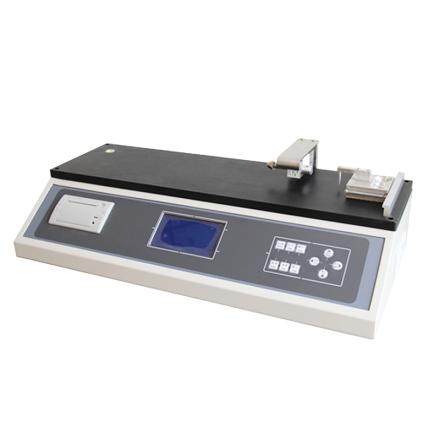
Overview
JW-120C Friction coefficient meter is based on GB 10006, ASTM D1894 and other national standards. It is professionally suitable for measurement Plastic film and sheet, rubber, paper, Cardboard, woven bags, fabrics, metal composite belts, conveyor belts, wood, coatings and other materials. Coefficient of Friction and dynamic Coefficient of Friction when sliding. By measuring the smoothness of materials, you can control and adjust the mass production process indicators of materials to meet the requirements of product use.
Features
1. The equipment is controlled by microcomputer, the test process is automated, and it is equipped with a menu-type operation interface, PVC control panel and LCD screen, which is convenient for users to conduct test operations and view data.
2. System accessories are high reputation manufacturers components, stable and reliable performance, High Accuracy Force Sensor, to achieve high test accuracy: 0.001N;
3. No mechanical knob, full digitalization system, digital correction and zero adjustment;
4. Specially designed drive system for smooth operation and more accurate test results.
5. The system can simultaneously measure the Static Coefficient of Friction and the Dynamic Coefficient of Friction;
6. Equipped with a micro-printer to automatically print test reports for single or group samples.
7. Organic Glass is used on the instrument test table, which effectively reduces the influence of the remanence of the metal table on the system test error.
Principle
Through the measurement of the friction when the material slides, the High Accuracy Force Sensor is used to detect the static and dynamic friction forces, and automatically calculate and display the static Coefficient of Friction and the dynamic Coefficient of Friction to evaluate the slippage of the material.
Applications
Plastic films and sheets, Rubber, paper, Cardboard, woven bags, fabric, metal composite belts, conveyor belts, wood, coatings
Standards
GB 10006、ASTM D1894
Steps
1. Connect the power supply and turn on the instrument;
2. Set the test parameters through the menu operation interface;
3. Place the specimen on the test table.
4. Start the test, the system automatically runs and measures the friction force;
5. The instrument automatically calculates and displays the Static Coefficient of Friction and the Dynamic Coefficient of Friction;
6. Use a microprinter to print the test report.
Notice
• Power supply voltage AC220V 50HZ;
• Check that the instrument table is clean before testing to avoid impurities affecting the results.
• Select the appropriate slider stroke and test speed according to the material characteristics;
• Regularly calibrate Sensors to ensure test accuracy;
• Avoid use in non-standard laboratory environments;
• Follow safety regulations when operating to prevent electric shock or mechanical injury.