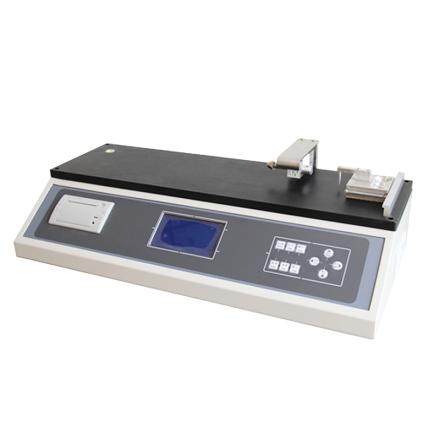
Overview
HUITAO HT-238M Coefficient of Friction Tester is a precision instrument for the measurement of Static COF and Kinetic COF when sliding a variety of materials. It is widely used in the slippery testing of Plastic films, metal materials, rubber, paper, fabric, conveyor belts, brake pads and other materials to help control production process indicators and meet product usage requirements. It can also be used for the measurement of slippery performance of daily chemical products such as cosmetics and eye drops.
Features
1. Provide three test modes of dynamic friction, static friction and dynamic and static friction for users to choose freely.
2. Test speed can be set, adjustable, support any slider mass.
3. Meet various testing standards such as GB, ISO, and ASTM, and the testing methods can be selected according to customer requirements.
4. The instrument test table and test slider are degaussed and remanence detected, effectively reducing the system test error.
5. The equipment is controlled by a microcomputer, with a menu-type Operating interface, control panel and LCD screen, which is convenient for test operation and data viewing.
6. System accessories and components have stable performance and good Repeatability.
7. Professional Software supports automatic single piece, group test results statistical analysis, original data source reanalysis, group Linear dispersion superposition comparison, and a variety of reporting modes to visually display test results.
8. Optional micro printer and standard RS232 interface are available to facilitate system connection and data transmission.
Principle
The instrument calculates Static COF and Kinetic COF by measuring the friction of the material during sliding. The user can choose different test modes, set the Test speed and slider mass, the instrument automatically executes the test and records the data, and performs Data analysis and result display through professional software.
Applications
Plastic films and sheets, metal materials, metal pipe fittings, rubber, paper, Cardboard, woven bags, fabric style, communication cables and optical cables with metal composite belts, conveyor belts, wood, coatings, brake pads, wipers, shoe materials, tires, cosmetics, eye drops and other daily chemical products
Standards
GB 10006、GB/T 17200、GB/T 22895、ISO 8295、ASTM D1894、TAPPI T816、GB/T 2792
Steps
1. Select the test mode (dynamic friction, static friction or static friction).
2. Test speed and Travel parameters.
3. Place the test sample and install the slider.
4. Start the test, the instrument automatically measures and records the data.
5. View the results on the LCD screen, or use software for Data analysis.
6. Optional printer output report or data transmission through RS232 interface.
Notice
• Ensure that the power supply is AC 220V 50Hz to avoid voltage instability affecting Test accuracy.
• Check whether the instrument table and slider have been degaussed before testing to reduce errors.
• Select the appropriate slider mass and size according to the material type.
• Follow the Touchscreen prompts when operating to avoid misoperation.
• Regularly calibrate the instrument to ensure accurate and reliable test results.
• Keep the instrument clean to prevent dust from affecting the test performance.