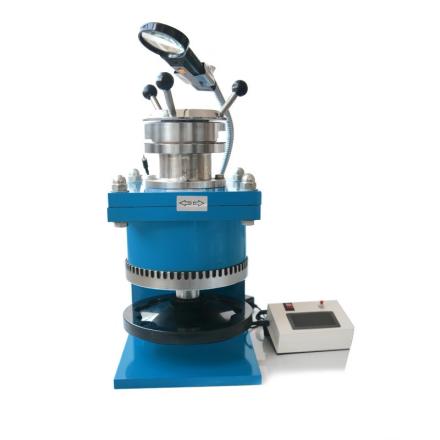
Overview
HuiNuo QBJ Cupping tester is designed and manufactured according to international standard ISO1520 and national standard GB9753-88. It is suitable for evaluating coatings (single-layer or supporting system coatings) of Paints, varnish and related products under the experimental methods specified in the standard. The instrument evaluates the performance of cracking resistance or resistance to separation from metal substrates by gradually deforming the coating, and judges whether the coating passes or does not pass. The minimum depth at which the coating just cracks or begins to break off the substrate can also be determined by gradually increasing the depth of indentation.
Features
1. Designed and manufactured according to international standard ISO1520 and national standard GB9753-88.
2, equipped with digital display device, resolution of 0.01mm, accurate reading.
3, with automatic zero (for single top coating) and manual zero (for double top coating) function, easy to operate.
4. High indentation accuracy, up to +/- 0.05mm.
5. The depression depth range is large, up to 10mm.
6. The diameter of the punch is standardized to 20 mm, meeting the test requirements.
Principle
The tester drives a spherical punch with a diameter of φ 20mm through mechanical transmission to indent the center of the fixed coating test plate at a constant speed (0.2 +/- 0.1mm/s). During the indentation process, the coating on the back of the test plate gradually deforms and bulges (forming "cupping"). The indentation depth is monitored and recorded in real time by the High Accuracy digital display device. When the preset depth is reached or the coating cracks or breaks off the substrate, the test is stopped to evaluate the flexibility, adhesion and cracking performance of the coating.
Applications
Paints coating evaluation, varnish coating evaluation, coating (single layer or supporting system coating) performance test of related products
Standards
ISO1520、GB9753—88
Steps
Preparation of test piece: prepare a flat polished steel plate test piece with a size of 70mm * 70mm and a thickness of 0.3mm~ 1.25mm, according to the standard Preparative and drying coating, thickness measurement, at a temperature of 23 +/- 2 ° C, relative humidity 50 +/- 5% environment state adjustment for at least 16 hours.
2. Single top coating laminate test (automatic zero adjustment): Turn the handwheel clockwise to the bottom, loosen the pressing device, insert the metal of the test plate facing down and the coating surface upward into the seam and align it with the center of the punch, and tighten the pressing device. Press the red zero button of the instrument, and the display returns to zero. Turn the hand wheel counterclockwise at a speed of 0.2 +/- 0.1mm/s. When the reading reaches about 0.40mm, the punch touches the test plate, and the instrument automatically adjusts to zero (the red light is on). Continue to rotate the handwheel. The display reading is the depth of indentation.
3. Double top coating laminate test (manual zeroing): Turn the handwheel clockwise to the bottom, loosen the pressing device, insert the random zeroing steel plate into the crack, and tighten the pressing device. Press the red button of the instrument to return to zero. Turn the hand wheel counterclockwise, slow down when the reading is close to 1.80mm, and stop when the red light of the instrument is on (the display is zero). Release the pressing device and manually clear again (press the red button). Then turn the hand wheel counterclockwise at a speed of 0.2 +/- 0.1mm/s, and the display reading is the depth of indentation.
4. Results check: Check whether the test piece coating is cracking or separated from the substrate with corrected vision or 10x magnifying glass.
5. Sexual repeability test: The above procedure should be carried out on two separate test pieces. If the results are different, the test will be supplemented until the results are consistent. If the substrate is crazing, the experimental results are invalid.
Notice
• The test piece should be flat without deformation, and the material should be polished steel plate that meets the requirements of GB9271.
• The coating test piece must be adjusted in a standard environment (temperature 23 +/- 2 ° C, relative humidity 50 +/- 5%) for at least 16 hours before testing.
• The single top coating laminate test adopts automatic zero adjustment mode, and the double top coating laminate test requires random zero adjustment steel plate and manual zero adjustment mode.
The rotation speed of the handwheel should be kept constant at 0.2 +/- 0.1mm/s (about 2 to 3 seconds).
• The direction of rotation of the handwheel during the test is irreversible, otherwise the reading will be inaccurate.
• When checking coatings, use corrected vision or 10x magnifying glasses for careful observation.
• The test needs to be conducted on two separate test pieces, and the test should be supplemented if the results are inconsistent.
• If the substrate itself is crazing during the test, the test result is invalid.