
A damp-heat test chamber is a type of equipment used to create and control specific temperature and humidity environments in a laboratory environment. Its core function is to simulate the hot and humid climate conditions that may be encountered in nature or during the life cycle of the product, and to observe and evaluate the changes in the physical properties, chemical stability, electrical properties and overall reliability of materials, products and components in the humid and hot environment by applying specified temperature and humidity stresses to the test samples. It is not only a basic tool for product quality control and R&D verification, but also a core platform for implementing various environmental stress screening, reliability growth tests and weather resistance assessment, and is widely used in electrical and electronics, auto parts, aerospace, new energy, medical instruments and new material research and development.
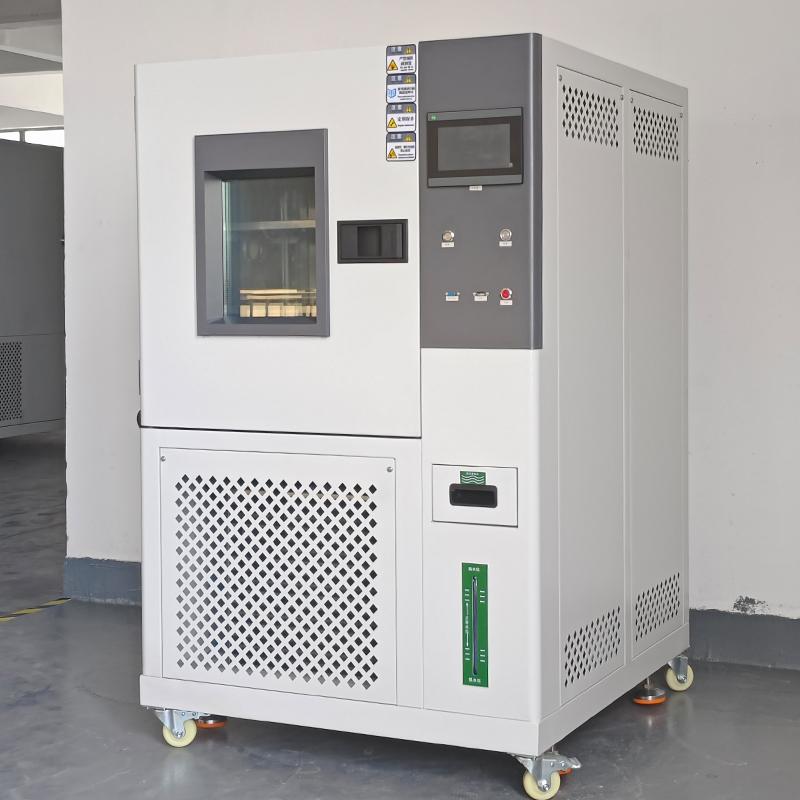
Principle
The operation of the damp-heat test chamber is based on thermodynamics and mass transfer, and the regulation of its internal environment is mainly completed by independent temperature control and humidity control system.
Temperature control includes two subsystems: heating and cooling. Heating usually uses electric alloy wire as the heat source, and the circulating fan promotes the convection of air in the box, bringing the heat evenly to all parts of the studio. Refrigeration generally adopts vapor compression refrigeration cycle, which uses the physical state change of the refrigerant in the compressor, condenser, throttling mechanism and evaporator to absorb the heat in the box to achieve cooling. For chambers that need to reach a lower temperature range, a stacked refrigeration system is often used, using two- or multi-stage refrigeration cycles to obtain lower evaporation temperatures.
Humidity control mainly relies on the balance between humidification and dehumidification functions. A common humidification method is electric steam humidification, which produces water vapor by heating the water in the sink, and the steam is mixed into the circulating air in the chamber by a fan. Dehumidification usually relies on the evaporator of the refrigeration system, when the high-humidity air in the chamber flows through the low-temperature evaporator surface, the water vapor in the air will condense and precipitate, thereby achieving the dehumidification effect. The control system senses the environmental state in real time through a platinum resistive temperature sensor and a humid-sensitive capacitor or wet and dry bulb sensor located in the chamber and feeds the signal back to a programmable logic controller. According to the preset program and algorithm, the controller calculates the amount that needs to be heated, cooled, humidified or dehumidified, and precisely drives the corresponding actuating parts to form a dynamically balanced closed-loop control.
Measurement method
The performance of the damp heat test chamber needs to be confirmed according to the measurement methods specified in national and international standards. The core parameters of measurement mainly include temperature deviation, temperature fluctuation, temperature uniformity and humidity deviation.
Measurements are usually taken at no load or under load conditions specified by the standard. A sufficient number of measuring points need to be arranged in the working area of the box. For boxes with a volume greater than or equal to a certain volume, nine or fifteen measurement points, including geometric centers, are usually arranged on the upper, middle, and lower levels. The measuring instrument needs to be calibrated by measurement, and its response time and accuracy should meet the test requirements.
In steady state, the following key indicators can be calculated from the readings of all measurement points over a certain period of time:
Temperature deviation refers to the difference between the maximum and minimum temperature measured by each measurement point and the set temperature within a specified time. Temperature fluctuation refers to the change of temperature over time at the center of the workspace or any measurement point within a specified time, usually expressed as half of the difference between the measured highest and lowest values, and is marked with the "±" sign. Temperature uniformity refers to the arithmetic average of the difference between the measured maximum temperature and the minimum temperature at each measurement point within a specified time.
Humidity measurement is carried out simultaneously with temperature measurement. For the system using the dry and wet bulb method, the principle is based on the temperature of the wet bulb thermometer lower than the dry bulb temperature due to water evaporation and heat absorption, and the relative humidity can be derived through the temperature difference between the dry and wet bulb and the saturated water vapor pressure formula. Modern devices often use electronic humidity sensors to measure relative humidity directly. Humidity deviation is calculated similarly to temperature deviation, which is the difference between the actual humidity and the set humidity in the workspace.
Analysis of factors affecting trial results
The accuracy and reproducibility of damp-heat test results are influenced by a combination of factors, and understanding these factors is crucial for proper equipment usage and interpretation of test data.
Airflow organization is the primary factor. The speed, direction, and uniformity of air flow in the chamber directly affect the efficiency of heat and moisture exchange on the sample surface. If the airflow speed is too slow or there are dead angles, it will lead to uneven temperature and humidity fields around the sample; If the airflow speed is too fast, it may cause physical disturbances to some lightweight samples or accelerate their surface heat dissipation, affecting the authenticity of the failure mode.
The characteristics of the sample itself are just as critical as the way it is placed. The volume, shape, heat capacity, and surface material properties of the sample affect its own temperature and humidity response. Samples should not overlap or obstruct each other in the box to ensure that each sample surface is fully exposed to the circulating airflow. The material and structure of the sample holder should also be selected with little impact on temperature and humidity conduction.
Radiant heat exchange is also a factor that cannot be ignored. The temperature of the inner walls of the chamber may differ from the temperature of the air inside the chamber, especially during rapid temperature rises and downs. If the radiative heat transfer between the sample and the inner wall accounts for a large proportion, the actual perceived temperature of the sample will deviate from the air temperature, introducing measurement errors. Cabinet designs often reduce this effect through inner wall processing and airflow organization.
Water quality has a direct impact on the accuracy and long-term stability of humidity control. If the water used for humidification contains too many minerals or impurities, it will not only clog the humidifier lines and affect the humidification efficiency, but also bring impurities into the box and contaminate the sample surface. Therefore, the use of purified or distilled water is often required as a water source.
Applications
The application of damp heat test chamber covers the whole process of product research and development, production to failure analysis, and its test methods are mainly based on IEC, ISO and the corresponding national standards of various countries.
In the field of electrical and electronic products, it is mainly used to evaluate the insulation performance, corrosion resistance and electrical safety performance of products under high temperature and high humidity conditions. For example, the steady-state humidity heat test investigates the expansion and strength changes of materials after moisture absorption. The change of day and night temperature difference was simulated by alternating humidity and heat test, and the electrical and mechanical properties of the product in the condensation state were investigated.
In the automotive industry, humidity heat testing is used to verify the resistance of components when used in the engine compartment or in different climates, such as aging of plastic parts, tightness of rubber parts, and corrosion of metal parts. The coatings and polymer materials industry uses moisture-heat testing to accelerate the aging process and evaluate the weathering resistance and service life of materials.
The pharmaceutical and medical industries have strict requirements for environmental cleanliness and stability. The damp heat test chamber is not only used to investigate the stability of pharmaceutical packaging materials and medical devices, but also to simulate environmental conditions during transportation and storage to ensure that the product is safe and effective within the validity period. In the field of new energy, especially in the testing of photovoltaic modules and power batteries, the damp heat test is a key link in evaluating its resistance to environmental aging, and is used to test the reliability of packaging materials, cells, and modules in harsh environments.
Consideration dimensions for selection
Choosing the right damp heat test chamber requires a comprehensive evaluation of multiple dimensions such as technical needs, usage scenarios, and long-term operating costs to ensure that the equipment can not only meet current test requirements, but also adapt to future development needs.
First, it is necessary to clarify the criteria on which the test is based. Different standards may have different requirements for the rate of change in temperature and humidity, uniformity, deviation, and load conditions. For example, there are differences in the control ability requirements of equipment between steady-state test and alternating test. It is necessary to ensure that the technical specifications of the selected equipment cover or exceed all test standards planned for future implementation.
Secondly, pay attention to the volume of the working chamber and the sample size. A basic principle is that the sample volume should not exceed a certain percentage of the effective volume of the chamber, and that there should be sufficient airflow channels between the sample surface and the chamber wall to ensure temperature and humidity uniformity. At the same time, the total mass of the sample should be considered to avoid exceeding the load-bearing limit of the sample holder.
Then, evaluate the temperature and humidity control range and capability of the equipment. It is necessary to confirm whether the lower and upper temperature limits of the equipment and the humidity control range can cover the required test conditions. Special attention should be paid to the control accuracy under low temperature, low humidity or high temperature and high humidity conditions, because under these boundary conditions, the control difficulty of the system increases, and the performance indicators may change.
In addition, it is necessary to consider the control system functions, data logging and interface capabilities, safety protection measures, and energy consumption and maintenance convenience for long-term operation. An easy-to-programm, multi-level permission management, and comprehensive data traceability control system can significantly improve laboratory productivity and data compliance.