
In the field of coating mechanical property testing, the Pencil Hardness Test has become the "gold standard" for evaluating the scratch and indentation resistance of coating surfaces due to its ease of operation, intuitive and efficient operation. However, in the face of manual, electric and various pencil sets, many customers are often confused: why do different people test the same pencil differently? Is it a pencil problem, or is it an instrument problem?
As a technician, I will systematically sort out the selection logic of pencil hardness tester for you from four dimensions: test principle, standard requirements, pencil selection, and instrument structure.
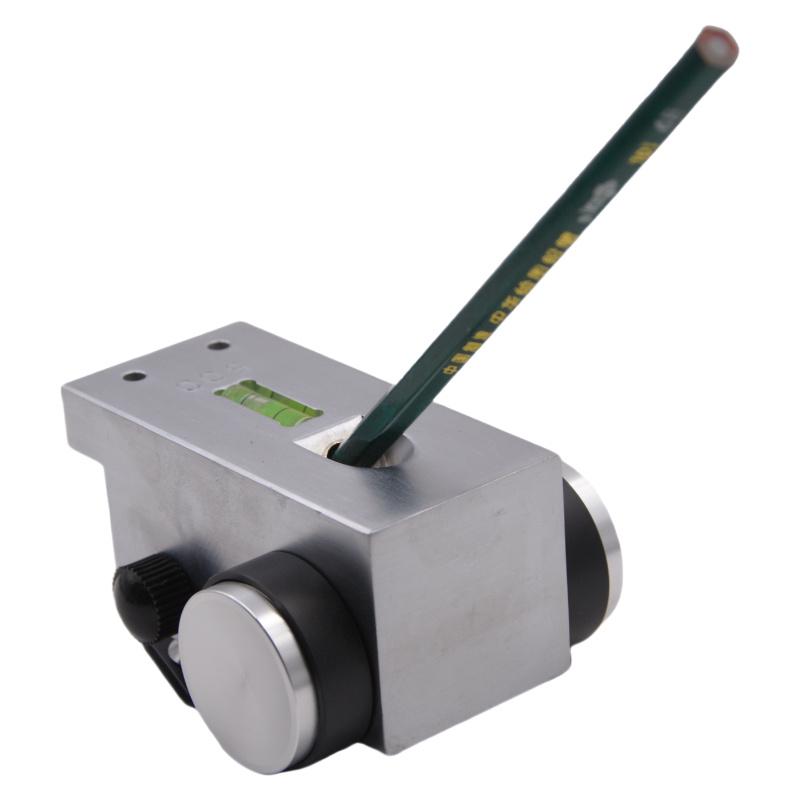
1. The core principle of pencil hardness testing: not just "drawing"
The essence of pencil hardness testing is to use a graphite pencil of a specific hardness to scratch the surface of the coating under a specific load and angle to determine the hardness critical point where the coating is just not scratched or scratched.
There are two key points to understand here:
1. "Scratch" vs "Scratch": Standards usually distinguish between two failure modes – marks only (plastic deformation) or completely scratching the coating to expose the substrate. The purpose of your test determines the rating criteria.
2. Diversity of pencils: From 6B (softest) to 9H (hardest), the actual hardness of pencils of different brands may vary even if their nominal hardness is the same.
Selection enlightenment: A set of reliable pencil hardness testers must be able to constantly control the angle and pressure between the pencil and the coating, and eliminate the error caused by human hand shaking and uneven force.
2. The core basis of selection: standard and pencil
1. Determine the instrument type according to the test standard
Different international standards have clear requirements for the mechanical structure of the test instrument, which directly determines whether you should choose a manual or automatic type.
| Test Standards | Core requirements | Recommended instrument type |
| ISO 15184 | The pencil is at a 45° angle to the coating, a constant pressure is applied (typically 7.5N±0.1N), and can be pushed manually or mechanically, but uniform speed is required. | Precision manual or electric type |
| ASTM D3363 | It also requires a 45° angle fixation, but emphasizes the operator's feel and experience. Manual pushing is allowed, but there are strict rules for the handling of pencil tips. | Manual type (with standard pencil set) |
| GB/T 6739 | Equivalent to ISO 15184, it clearly specifies the method of preparation of pencils and the mechanical mechanics requirements of the test instruments. | Mechanical type with weight loading is recommended |
Selection conclusion: If you only need a quick comparison of internal references, the manual type can be satisfied; If you need to issue a CNAS-certified test report, or if you need to eliminate errors between different operators, the electric type (automatic pencil hardness tester) is a safer choice.
2. Choice of pencil set: brand vs. standard pencil
Many customers underestimate the importance of the pencil itself. In the pencil hardness test, the pencil is the "measuring tool".
Standard Pencil vs. Commercially Available Pencil:
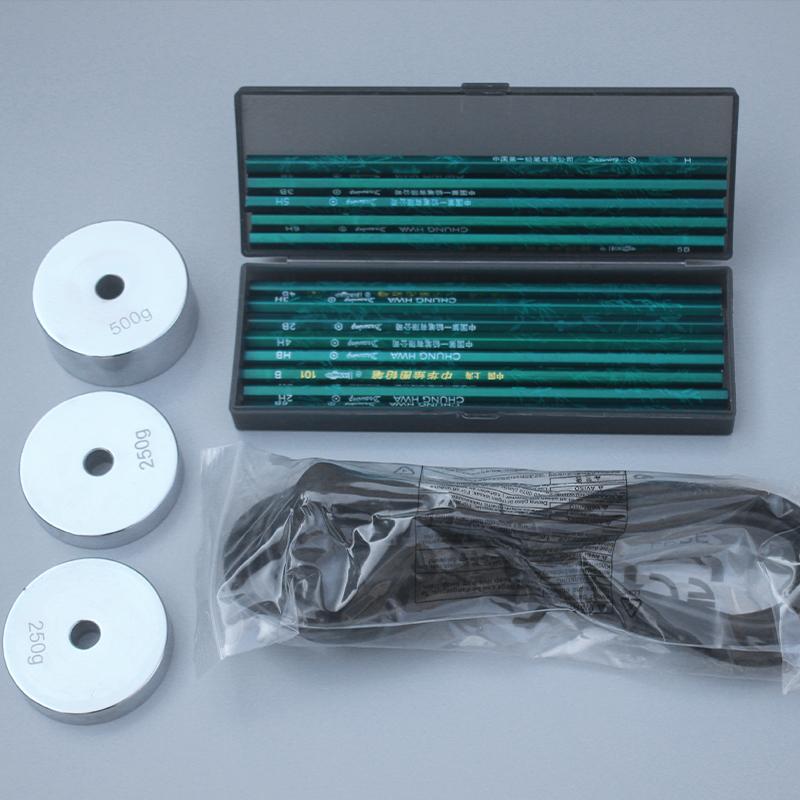
Commercially available drawing pencils (such as Mitsubishi and Huibojia) are marked with hardness grades, but their formulation is more for the painting feel than strict quality control. True standard test pencils are specially produced in accordance with ISO or ASTM standards, with a checked hardness value and tighter core uniformity and diameter tolerances.
Set range:
Conventional coating tests typically range from 6B to 6H. If you are testing superhard coatings (e.g., automotive varnishes, coil coatings), you need to extend to 9H; If it is an extremely soft plastic or wood coating, you need to pay attention to soft lead below 6B.
Selection conclusion: Always confirm that the pencil you purchase with the pencil hardness tester is a special test pencil that meets the standards, and check whether there is a hardness value calibration certificate or batch conformance certificate.
3. Instrument structure and process: determine repeatability
1. Manual type: Clever use of counterweights and guides
A manual pencil hardness tester may seem simple, but the difference between a good and bad product lies in the stability of the force application mechanism.
Weight Loading: Low-end products only rely on the operator's feel to press, and the error is extremely large. Professional manual models should be equipped with a weight or spring loading mechanism to ensure that the pencil's pressure on the coating is constant at the standard required 7.5N (or other custom force value).
45° Locking: The instrument must rigidly fix the 45° angle between the pencil and the coating and not offset the angle during pushing. The base with roller guide ensures that the scratch trajectory is straight and avoids jitter that can lead to different shades of scratches.
2. Electric type: Eliminates human variables
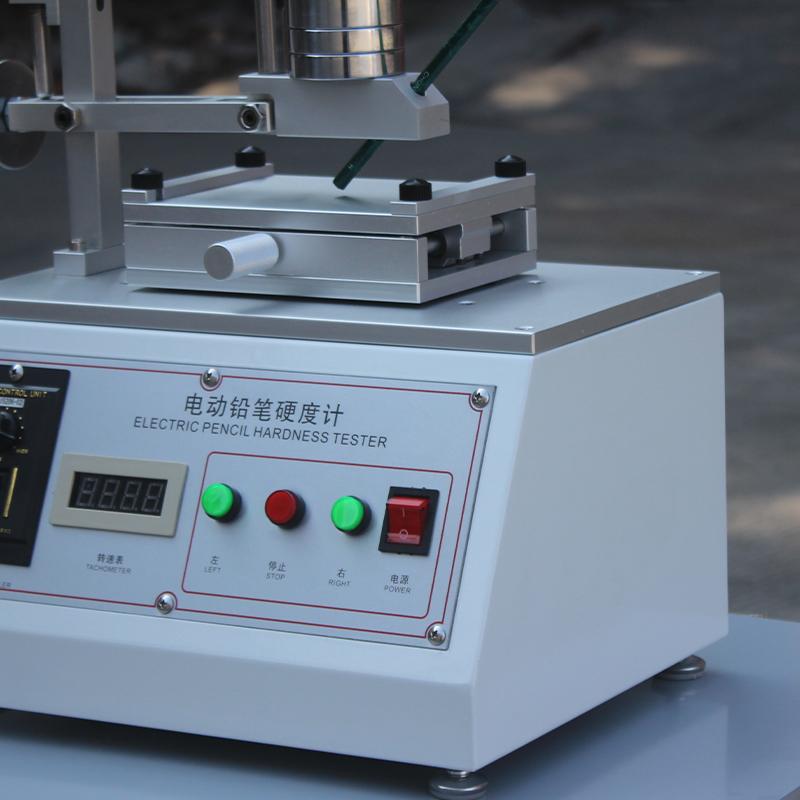
For R&D centers or third-party testing laboratories, the Electric Pencil Hardness Tester is the preferred choice to ensure data impartiality.
Constant speed: The motor drive pushes the pencil across the coating at a uniform speed (usually 0.5-1mm/s), eliminating the interference caused by acceleration and deceleration during manual pushing.
Precise loading: The positive pressure acting on the nib is precisely controlled by the balance bar and weight set, and some high-end models can also be loaded incrementally, finding a critical point in a single test without the need to change the pencil repeatedly.
Scratch Detection: Some advanced models are integrated with acoustic emission or microscope vision systems, which can automatically identify whether the coating has been scratched, turning subjective judgments into objective data.
4. Pencil preparation: a key link that has been overlooked
No matter how expensive the pencil hardness tester is, if the pencil is not prepared in a standardized manner, the test results will be invalid.
Pen sharpener: A regular pencil sharpener can cause microcracks or eccentricity inside the lead core. The standard test must use a special mechanical pen sharpener to cut off the wood to expose a 3-5mm lead core, and ensure that the lead core is cylindrical.
Sandpaper Grinding: The sharpened pencil must be sharpened vertically on 400# sandpaper until the tip is flat, smooth and free of debris, forming a standard square section. This square edge is the "blade" that really acts on the coating.
Selection Recommendation: When purchasing a pencil hardness meter, be sure to check if it includes a special sharpener and sandpaper. Without these two things, the whole set of equipment will not work properly.
5. Special needs and extended functions
Warming/Cryogenic Testing: If you need to test the hardness of the coating at different temperatures, choose a model with a temperature-controlled platform.
Film/Soft Substrates: For extremely thin coatings or soft substrates (e.g., films, textiles), conventional pencils are prone to collapse of the substrate, leading to misjudgment. In this case, a miniature pencil hardness tester or use with a rigid substrate fixture should be considered.
Scratch Length Control: Some standards require a scratch length of at least 7mm, and choosing an instrument with a limit switch or stroke adjustment can ensure a consistent length every time.
Summary: Five steps to selection
Clarify test objectives: in-house quality control or third-party certification? Decide whether to use a manual or electric model.
Follow the test standard: ISO 15184 or ASTM D3363? Confirm that the instrument's mechanical structure is compliant.
Choose a standard pencil: Use a validated standard hardness test pencil instead of a regular drawing pencil.
Focus on the force application mechanism: Ensure that the pencil can steadily stroke the coating at a 45° angle and constant pressure.
Complete with auxiliary tools: special sharpeners, sandpaper, eraser hammers (for special ratings) are also indispensable.
Pencil hardness test, seemingly simple, is actually full of details. Choosing a set of well-designed and well-equipped pencil hardness testers can not only improve the inspection efficiency, but also make your coating hardness data truly "hard" and withstand the inspection and reproduction of any party.


