
In materials science and engineering research, the preparation of uniform, repeatable films or coatings is the starting point for many experiments. Spin coater and flat plate coater are two common laboratory film making equipment, although the goals are similar, but there are significant differences in the physical principles, applicable material systems, and final film properties obtained. Understanding these core differences is a prerequisite for ensuring that your protocol matches the capabilities of your equipment.
Fundamental differences in how it works
The most essential difference between the two is that the driving force of the liquid spreading into a film is different. Spin-coaters use centrifugal force, while flatbed coaters rely on mechanical shear forces.
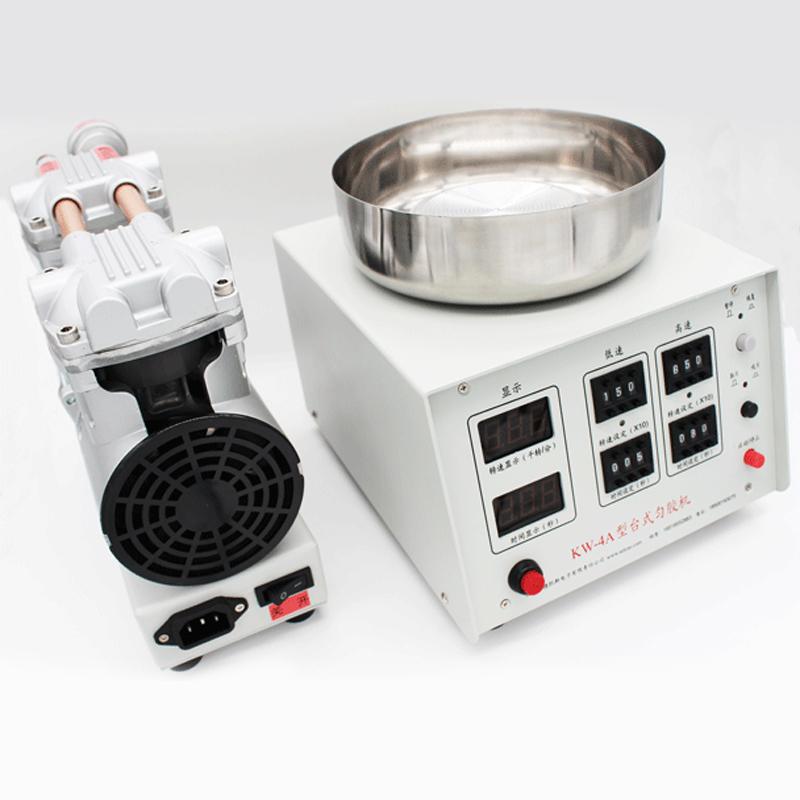
Rotary coating instrumentThe centrifugal force generated by the high-speed rotation of the substrate quickly throws the liquid material dripped into the center of the substrate towards the edge, and the excess liquid is thrown out of the substrate, and the solvent evaporates in the process, leaving a uniform film on the substrate. The membrane is thickhand angular velocityωThe square root of is inversely proportional, and for Newtonian fluids, its final film thickness can be simplified by the formula:
h ∝ 1/√ω
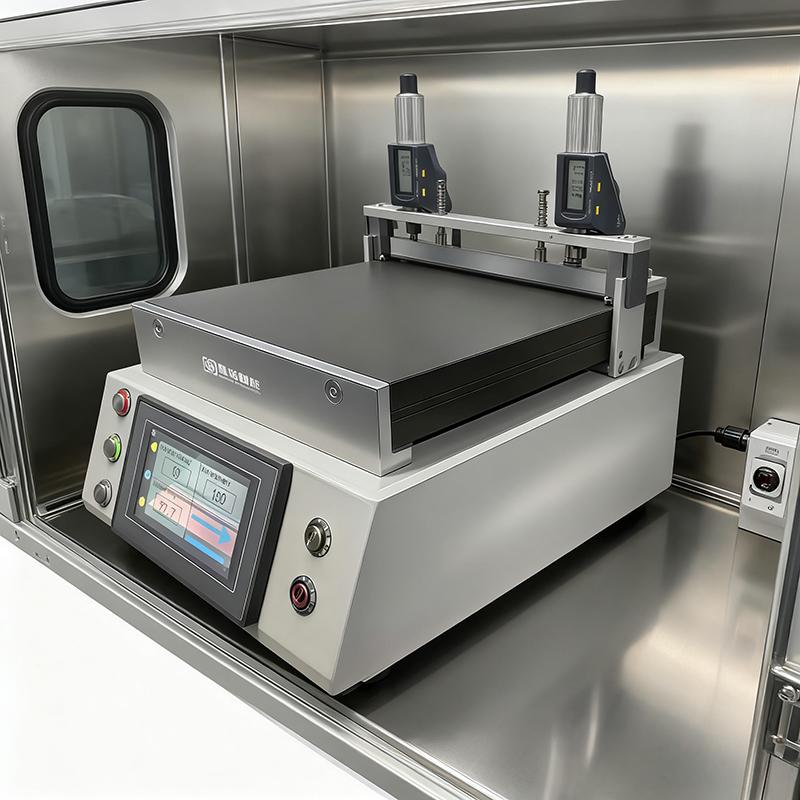
Flat Sheet Coating Machine(usually referred to as scraper type) is set by a precision scraper or coating rod to set the clearance heightg, moving at a uniform speed above the substrate. The liquid passes through the gap under the push of the scraper, forming a wet film. The thickness of its wet film is mainly determined by the scraper gapgand solution concentration, rheology determined, and coating speedvThere is a complex relationship, but it has nothing to do with centrifugal force.
Comparison of core differences
| Film formation driving force | Centrifugal force dominates, spreading the liquid through high-speed rotation. |
| Film formation driving force | Mechanical shear forces dominate, spreading the liquid through the relative motion of the scraper/wire rod. |
| Typical film thickness range | Nanoscale to several microns for ultra-thin coatings such as photoresists and sol-gels. |
| Typical film thickness range | Micron to hundreds of microns, suitable for thicker coatings such as battery electrodes, coatings, adhesives, etc. |
| Substrate requirements | Small-sized rigid sheets (such as silicon wafers, glass sheets), usually round or square, need to be firmly adsorbed by vacuum suction cups. |
| Substrate requirements | Relatively flat plates, films or foils can be large or small in size, and the rigidity of the substrate is not high, and can be fixed by vacuum plate adsorption. |
| Sample consumption | Very rarely, usually only a few microliters to a few milliliters, most of the material is thrown out and wasted during spinning. |
| Sample consumption | Relatively large, enough slurry is needed to fill the area in front of the scraper and form a stable "bead". |
| Uniformity control | The thickness is highly uniform across the entire substrate, especially in the central area, but there may be an "edge effect" at the edges. |
| Uniformity control | The lateral uniformity of the scraper direction is good, but there may be uneven thickness at the start and end positions, and an effective stroke needs to be set. |
Applicability analysis of application scenarios
Rotary coating instrumentThe applications are mainly concentrated in the fields of microelectronics, optoelectronics, nanotechnology, and optical thin films. For example, in the semiconductor process, uniform coating of photoresist on silicon wafers is a prerequisite for the lithography process; In solar cell research, for the preparation of perovskite or quantum dot active layers; In optics, it is used to deposit anti-reflective coatings on glass substrates. These scenarios are characterized by strict requirements for film thickness (usually at the nanoscale), uniformity, and cleanliness, and the substrate is a small standard sheet.
Flat Sheet Coating MachineIt is more widely used in general material testing, new energy batteries, coating inks and adhesive industries. For example, in lithium-ion battery research and development, the cathode and anode slurry is coated on aluminum foil or copper foil to evaluate its electrochemical properties; In the coatings industry, it is used to prepare paint films with precise thicknesses on standard test plates to test their hiding power, weather resistance, or drying time. In the field of adhesives, it is used to prepare adhesive layers to test peel strength. These scenarios focus more on simulating the coating process in actual production or testing the macroscopic performance of coating functionality, allowing relatively large film thickness errors and higher flexibility in substrate size.
Key process parameter considerations
When selecting equipment, operators need to pay attention to its core process parameters.
For spin coaters, key parameters include the speed range (e.g., 0-12000 rpm), acceleration (e.g., 12000 rpm/s), and the ability to edit multi-step programs. High accuracy and repeatability are core metrics, and advanced equipment may offer speed setting accuracy of <0.006%. In addition, the reliability of vacuum adsorption, the chemical resistance of the chamber, and the safety interlock function are also important considerations.
For flatbed coaters, the key parameters are the coating speed (e.g. 0-120 mm/s), the effective coating stroke (e.g. 0-1000 mm), and the adjustment accuracy of the squeegee (e.g. ±1 μm or ±3 μm). The flatness of the substrate vacuum adsorption platform directly determines the upper limit of the uniformity of the coating. In addition, whether it has the heating and drying function and whether it can be adapted to different types of coatings (such as wire rods and four-sided film makers) also greatly affects the application scope of the equipment.
Conclusion
The spin coater and flat plate coating machine are positioned for the preparation of "ultra-thin and high-precision functional films" and the construction of "controllable thickness macroscopic performance coatings", respectively. The former pursues special uniformity at the microscopic scale through centrifugal force, serving cutting-edge device research; The latter pursues the reliability and operability of coatings on a macro scale through mechanical scraping, serving a wide range of material research and development and quality control. Experimenters should reasonably select film making tools based on the target film thickness, substrate type, material cost, and the properties to be characterized.