
In the experimental process of material development, the reliability of the coating process often directly affects the validity of the final data. In our interactions with many R&D teams, we found that many seemingly subtle operation links can actually become the source of result bias. The design idea of Huinuo Experimental Automatic Coating Machine is based on the response to these specific problems, hoping to improve the repeatability and stability of coating experiments without increasing the operational burden.

Taking the cleaning of the wire rod as an example, the fixing nuts at both ends of the traditional wire rod not only require tools to disassemble and assemble, but also its threaded structure is prone to slurry residue. If not thoroughly cleaned, residues from the previous experiment can interfere with subsequent formulation testing, and this cross-contamination should be avoided in precision experiments. Huinuo has changed the fixing method of the wire rod to a snap-on structure, which no longer requires auxiliary tools for installation and removal, and more importantly, it removes the threaded parts that are easy to hide the slurry, making the cleaning process more thorough and reducing the risk of cross-contamination at the source.

The maintenance cost of the scraper module is also a concern for laboratories. After long-term use, traditional scraper assemblies often need to replace the entire tool holder assembly once the cutting edge wears out, which is a significant ongoing expense for high-frequency laboratories. The clamshell magnetic scraper design adopted by Huinuo allows daily cleaning to be completed by simply opening the top cover and removing the scraper blade. When the scraper blade reaches the end of its useful life, it is also necessary to replace the blade instead of replacing the entire component, which helps reduce long-term consumables costs in the lab.
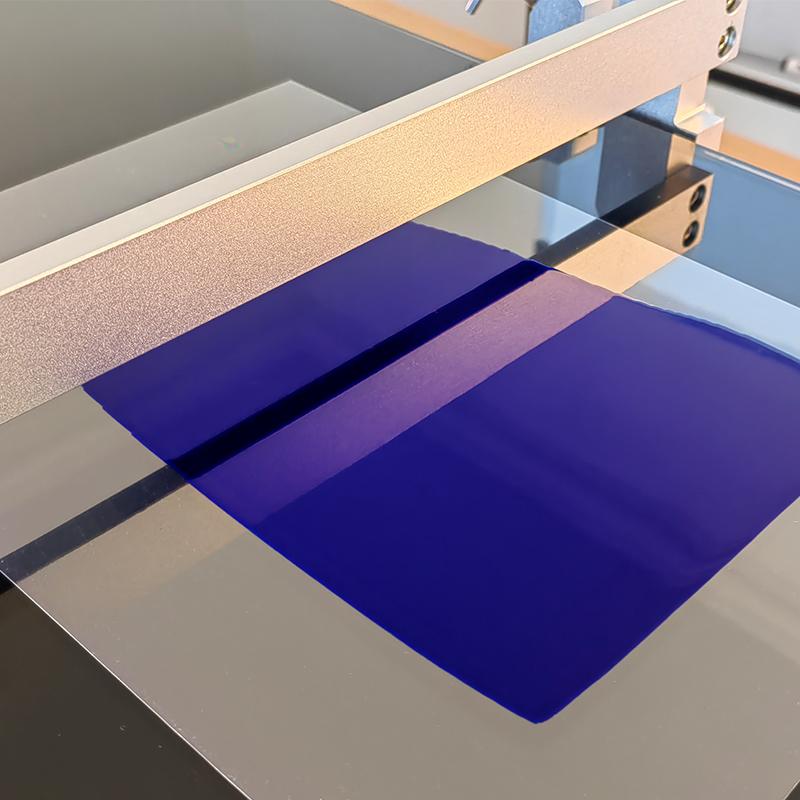
The stability of the coating process directly affects the uniformity of the film thickness. If the coating head runs at an uneven speed, or if there are microscopic undulations on the tabletop, the thickness of the coated film may vary in different areas, which will affect the subsequent performance test results. Huinuo uses a high-performance servo motor as the driving component, which improves the smoothness of operation compared with the traditional motor, and can ensure that the coating head moves at a constant speed within the full stroke range. At the same time, the coated countertop adopts ultra-flat 3D printing-grade glass plate or aluminum alloy base plate with surface oxidation treatment, which has a higher flatness than conventional countertops. Considering that there may be unevenness that is not easily noticeable to the naked eye on the laboratory countertop, adjustable support feet are designed at the bottom of the device, which can be fine-tuned according to the actual placement environment to ensure that the substrate is always level during the coating process.

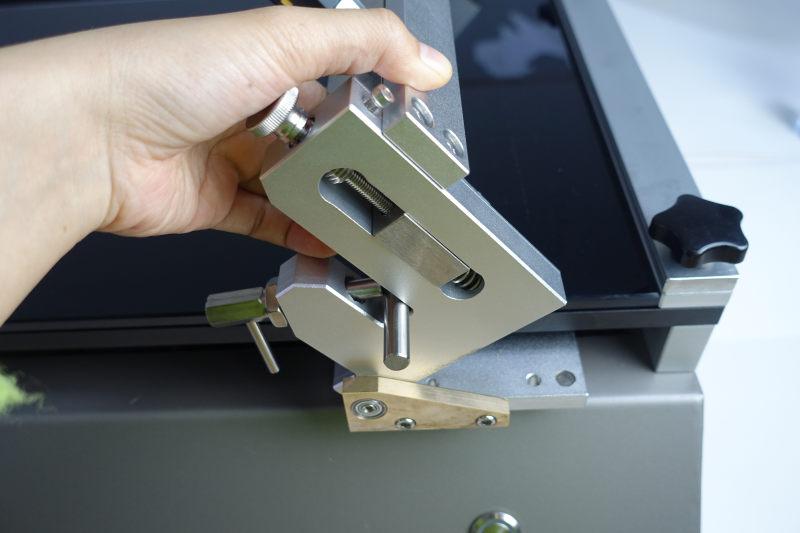
In terms of substrate fixation, if the cut PET film, aluminum foil and other substrates slip or wrinkle during the coating process, the coating results will be difficult to meet expectations. The dual clamps equipped with Huinuo can secure the edges of the substrate from both sides, keeping it flat and tight throughout the coating stroke, reducing coating defects caused by substrate movement. For applications that require heated coating, heating uniformity is as critical as responsiveness. The thermal conductivity of mica material helps heat to be more evenly transferred to the entire working surface, and with the temperature control system, the set temperature can be maintained more accurately, providing more stable process conditions for the coating of temperature-sensitive materials.
From the convenience of disassembly and maintenance to the material selection and structural design of key components, the improvements of Huinuo experimental automatic coating machine are based on common problems in actual experimental operations. We hope that these details will allow developers to focus more on the study of the material itself, rather than the uncertainty caused by the operation of the equipment.