Overview
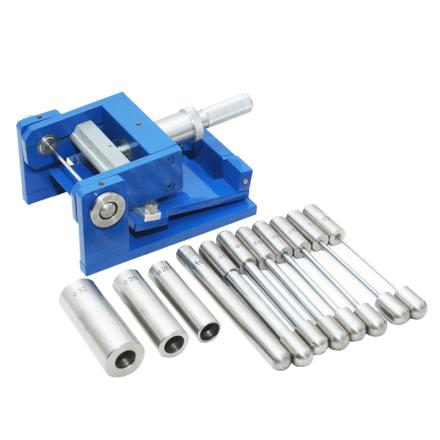
The QTY-32 cylindrical film Bending tester is a special testing instrument under the HuiNuo brand, which is mainly used to measure the flexibility of Paints and varnish films. The instrument provides an important reference for the selection of paint varieties and is one of the key indicators to measure the performance of coatings by evaluating the cracking or disbonding performance of coatings when they are bent around cylindrical mandrel of different diameters under standard conditions.
Features
Equipped with a variety of shaft rods, with diameters covering 2, 3, 4, 5, 6, 8, 10, 12, 16, 18, 20, 25, and 32mm, to meet different testing requirements.
2. Manual Operation mode is adopted, and the structure design is convenient for smooth operation and sample insertion.
3. It is suitable for testing samples with a thickness of less than 1.0mm.
4. In line with the national standard GB/T 6742, the test results are authoritative and comparable.
Principle
The instrument works based on the principle that films have different ductility properties of substrates at different bending radii. The film flexibility is determined by smoothly bending the coated sample film 180 ° around a cylindrical mandrel of selected diameter in 1-2 seconds, and then immediately checking whether the coating is cracking or disbonding from the baseplate (regardless of the coating within 10mm of the edge of the plate).
Applications
Paints, varnishes and coatings performance testing and evaluation
Steps
1. Spreader, drying sample and thickness measurement as required.
2. Place the instrument on the edge of the workbench to ensure that the adjustment handle is freely operated.
3. Select the appropriate shaft rod according to the product requirements, insert it into the base hole and fasten it with a lock mother.
4. Turn the handwheel to lower the pallet, insert the sample film face down between the shaft rod and the adjustment handle, and press it on the pallet with beads and screws.
5. Turn the handwheel to lift the pallet so that the sample is close to the shaft rod.
6. Put the adjustment handle to the lowest level and adjust the compression shaft knob on it so that the compression shaft is close to the sample.
7. Lift the adjustment handle 180 degrees smoothly (non-abruptly) within 1-2 seconds, causing the sample to bend accordingly.
8. Turn the handwheel to lower the pallet, so that the bent sample is removed from the shaft rod and removed.
9. Immediately check the sample, with normal vision or 10 times magnifying glass to observe whether the coating is cracking or disbonding, if using magnifying glass to indicate.
10. To determine the minimum shaft diameter that causes damage, smaller diameter shafts can be used in turn, and the repeability test can be carried out until the shaft diameter that causes film cracking or disbonding is found and verified with a new sample. If the minimum shaft diameter (2mm) does not cause damage, the result is recorded.
11. The test should be carried out in an environment with a temperature of 23 +/- 2 ° C and a relative humidity of 50 +/- 5%.
Notice
* In order to prevent damage to the coating during bending operation, a thin paper can be lined on the sample film surface before testing.
* If 10x magnifying glass is used to observe the test results, it must be clearly indicated in the record.
* Even if the smallest diameter of the shaft rod coating is not damaged, the diameter of the shaft rod should be recorded.
* If the sample is Aluminum Panel, its long side direction should be parallel to the calendering direction of the material.
When the instrument is not in use for a long time, anhydrous Vaseline should be applied to the surface of all shaft rods to prevent rust.