Overview
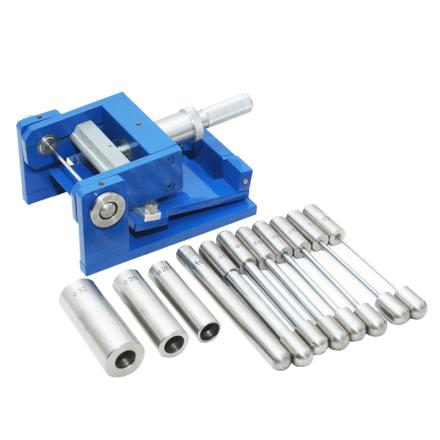
The QTY-32 cylindrical Bending tester is a test instrument used to evaluate the ductility and adhesion of coatings under bending stress. The instrument quickly checks the coating for cracking, flaking and other damage by bending the Spreader metal substrate 180 ° on a cylindrical mandrel with a set radius to determine its resilience.
Features
1. The main body is made of anodic oxidation aluminum, which is sturdy and durable.
Equipped with 12 stainless steel shaft rods of different diameters, the diameter range covers 2mm to 32mm.
3. Test plates with a maximum width of 50mm can be tested.
4. Simple and fast operation, can effectively evaluate the ductility and adhesion of coatings.
Principle
The tester bends a coated metal plate 180 degrees around a cylindrical mandrel of known diameter by applying uniform force over 1-2 seconds. The coating's resilience and adhesion are evaluated by sequentially testing with decreasing diameter shafts to see if the coating is cracking or flaking.
Applications
Coating performance testing, coating development and quality control, metal surface preparation evaluation
Standards
GB/T 6742-2007、ISO 1519-2011
Steps
1. Spreader the paint evenly on the metal substrate, and carefully film and dry to ensure the test reproducibility.
2. Start with the largest diameter shaft rod and bend the Testing substrate to 180 ° with uniform force within 1-2 seconds.
3. Check the coating for fracture, flaking or Miscellaneous damage.
4. Decrease the diameter of the shaft rod and test the repeability until the coating is observed to be damaged.
Notice
• Before testing, ensure that the coating has been through drying to ensure the accuracy and reproducibility of the test results.
The bending operation should be completed uniformly within 1-2 seconds to avoid impact or uneven force affecting the test results.
• The test should start from the maximum diameter shaft rod and gradually reduce the diameter to accurately find the critical point of coating failure.
• Please keep the shaft rod and the main body of the instrument properly after use to avoid collision damage.