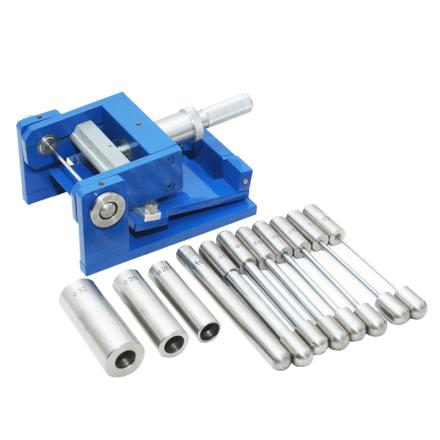
Overview
The JINGKELIAN QTY-32 cylindrical mandrel bending tester is used to measure the ability of the paint film to deform with the substrate without damage under standard conditions, and to evaluate the flexibility of the paint film. The device represents the test result by the minimum shaft rod diameter that does not cause the paint film to crack after the plate is bent 180 degrees around the shaft rod.
Features
1. Comply with a number of international and domestic standards, including GB/T6742-86, ISO1519-73, ASTMD522, DIN53152
2. Available in a variety of shaft rod diameters, from 2mm to 32mm, covering a wide range of testing requirements
3. Compact, with a size of 200 x 100 x 130mm, making it easy to operate and store
4. Suitable for test plate substrates with thickness not greater than 1.0mm, such as polished steel plate and tinplate
5. The test process is fast, and the bending operation is completed within 1-3 seconds to ensure the accuracy of the results
Principle
Based on the standard, the tester bends the coated plate 180 degrees around the shaft rod in 1-3 seconds, and evaluates the flexibility by observing whether the film is cracking. The minimum shaft rod diameter that does not cause the film to crack is used as the evaluation index. The smaller the diameter, the better the film flexibility.
Applications
Coatings industry, film performance testing, material flexibility assessment, quality control
Standards
GB/T6742-86、ISO1519-73、ASTMD522、DIN53152
Steps
1. Coating on a 35mm (1.38 inch) wide and 0.3mm (12mil) thick metal plate
2. Carefully film and dry it to ensure good reproducibility
3. Bend the coated sample to 180 degrees with uniform force within 1-2 seconds
4. Start with the maximum radius cylindrical mandrel and decrease the radius test until the coating can be seen to break
Notice
• Ensure that the thickness of the test plate substrate is not more than 1.0mm, it is recommended to use polished steel plate or tinplate
• Dry after film to ensure test reproducibility
The bending operation should be completed evenly within 1-2 seconds to avoid affecting the result too quickly or too slowly
• Start with the maximum shaft diameter and gradually decrease to determine the minimum cracking diameter
• Check whether the shaft rod size meets the test requirements before operation, ranging from 2mm to 32mm